Schermerhorn |
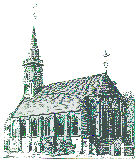
The Main Church of Schermerhorn
The Main Church of Schermerhorn is part of the group of church buildings built in the Republic of the Seven United Netherlands in the first half of the seventeenth century as a
Reformed State church. Inside we see an example of an original protestant church interior. The first stone was laid on 12 June 1634, as is written on the commemorative stone above the entrance door in the western facade. The church was inaugurated in 1636. It was constructed in late Gothic style as a so-called pseudo basilica. The very slimline tower is characterized by renaissance influences. The church has three naves and a hexagonal choir.
The memorial sign above the main entrance tells us something about the main church's previous history. At the present location of the church, a chapel was built around 1520, which was expanded in 1614. In 1634 Schermerhorn appeals to the state for permission to build a larger church in view of the fact that 'its inhabitants are prevented from joining God's congregation because of the small church'. The chapel was pulled down that very same year and 'on that square later on this beautiful building is erected' (1636). Jan Jansz Vijselaer van Edam built the church. His name can be seen on one of the vault's beams.
In 1699, during the great fire of Schermerhorn, the ecclesiastical archives were destroyed, making it difficult to adequately explain all of the interior's background.
The interior is of great interest. In the northern facade and in the choir you find ornamental stained windows. The six choir windows were donated by some important surrounding towns: Medemblik, Edam, Hoorn, Alkmaar, Enkhuizen and Mon-
nickendam. In former years, there used to be a window from Purmerend. However, this window was destroyed, just like the stained windows in the southern facade. The five windows in the northern facade were donated, among others, by the States of Holland and private individuals. The stained windows are unique because they mainly contain the original glass; this can be gathered from the transparent character of the flamboyant paintings. The wooden barrel vault was painted with floral designs: grapevines, stylized lilies and fruits. The vault was painted over in 1767. The ambulatory next to the tower was built for the benefit of the parish, as appears from the text on the outside partition. As the story goes, the rooms also served as a prison. The oak church furniture, such as the splendidly carved pulpit, the baptismal gate and the five pews around the pillars all go back to the seventeenth century.
The two ship models hanging from the vault embellish the interior. The first ship, which is 0.90 metre long, goes back to 1663. The second ship is a 0.80 metre long block model of a war ship. Three brass chandeliers show the coat of arms of the city of Haarlem and a mole on their shields; the mole occurs in the Schermerhorn coat of arms.
Other objects worth seeing are the baptismal font, an inside clock, the above mentioned memorial sign above the entrance, the ordonnance sign, the ten commandments sign, the mourning sign and the grave plan. There are a great number of grave-stones, many of which can be clearly identified. Two seventeenth century clocks hang in the belfry; the smallest of which, 0.90 metre in diameter, was cast by F and P Hemony in Zutphen in 1653. The organ was built in the eighteenth century and was made in Rhineland. It was placed in the choir in 1879. From there it was relocated to the room above the consistory in 1896. In 1973, after a thorough and costly restoration, the organ was moved to its present location near the pulpit. The organ has 19 registers and an attached pedal.
The church was completely restored between 1950 and 1975. Recently, the church's roofs and tower were provided with new slates. The stained windows were also completely restored in 1995 and equiped with protective glass and grating. After both renovations had been completed, a performance of 'the cuckoo-flower' was held in the church, a farce reminiscent of the spring festivals in ancient times.
Schermerhorn's Main Church is used for church services in summer and during winter feasts. In summer months the church is open to the public on Saturdays and Sundays. The church is available for cultural events. For further information please contact the secretary of the Foundation 'Friends of the Main Church of Schermerhorn', telephone number 072 502 2047.
Stichting "Vrienden van de Grote Kerk-Schermerhorn"